A model can work and the decision can still fail
Picture a hotel that receives a solid staffing recommendation at 10:15 a.m. The model has the right demand signal. The recommendation makes sense. The manager can see it.
At 10:45, nothing has changed.
Maybe the recommendation landed in a dashboard nobody was watching. Maybe the department head saw it but wasn't sure she could modify the schedule. Maybe approval sat with someone off property. Maybe the schedule changed, but nobody told the employees affected by it.
The model can be right at every step and the operating decision can still fail. That is the problem this article is trying to isolate.
There is some grounding for this in research on earlier waves of information technology, though none of it validates the idea in hotels. Brynjolfsson and Hitt (2000) reviewed case and firm-level evidence showing that the value of IT depended heavily on complementary organizational changes, including processes, work practices, and decision structures. Melville, Kraemer, and Gurbaxani (2004) similarly framed IT business value as depending partly on complementary organizational resources. The technology by itself was only part of the intervention.
That doesn't prove orchestration is the next bottleneck in hotels. It does support a more modest idea: useful technology and useful operations are not the same thing.
Integration is necessary, but it isn't orchestration
Hotels already know they have an integration problem. The stack is full of specialized systems for reservations, revenue, labor, accounting, maintenance, guest communication, business intelligence, and more, and those systems need to exchange information.
But a successful integration only answers part of the operating question. It can tell us a message moved from System A to System B. It doesn't necessarily tell us:
- Was the data authoritative?
- Did the recommendation use the right context?
- Who had authority to approve or change it?
- Was a conflict with another recommendation resolved?
- Did the action actually happen?
- Was the result good?
- Did the action cause the result?
Integration moves data. Orchestration coordinates a decision.
A single product can do both. A suite can fail at both. A collection of specialized tools can orchestrate well if the operating design is strong.
None of this argues for a single vendor. Whatever the stack looks like, someone still has to design the whole decision.
From systems of record to systems of action
Enterprise software has used terms like system of record for years. HDL isn't claiming these concepts originated at the Destination AI conference.
For this article, the useful distinction is functional:
- A system of record preserves authoritative operational facts and history.
- A system of intelligence interprets those facts and produces a forecast, insight, or recommendation.
- A system of action carries out an authorized operational response.
One application may perform all three functions.
What AI changes is how short the distance between interpretation and action can get.
Reading a reservation is one capability. Recommending a staffing change is another. Changing the schedule is another. Sending an employee home is another. Those actions shouldn't automatically inherit the same authority just because they sit inside the same workflow.
That fits the current HDL Canon, which separates:
Prediction → Recommendation → Operating Decision → Execution → Outcome
A forecast can be trusted for prediction without being granted authority over a personnel action. That distinction gets more important as systems get easier to connect, not less.
A practical way to trace the decision
Instead of adding a second decision-rights framework, HDL can use a simple operating trace built around the Canon:
Observe → Contextualize → Propose → Route → Authorize → Execute → Learn
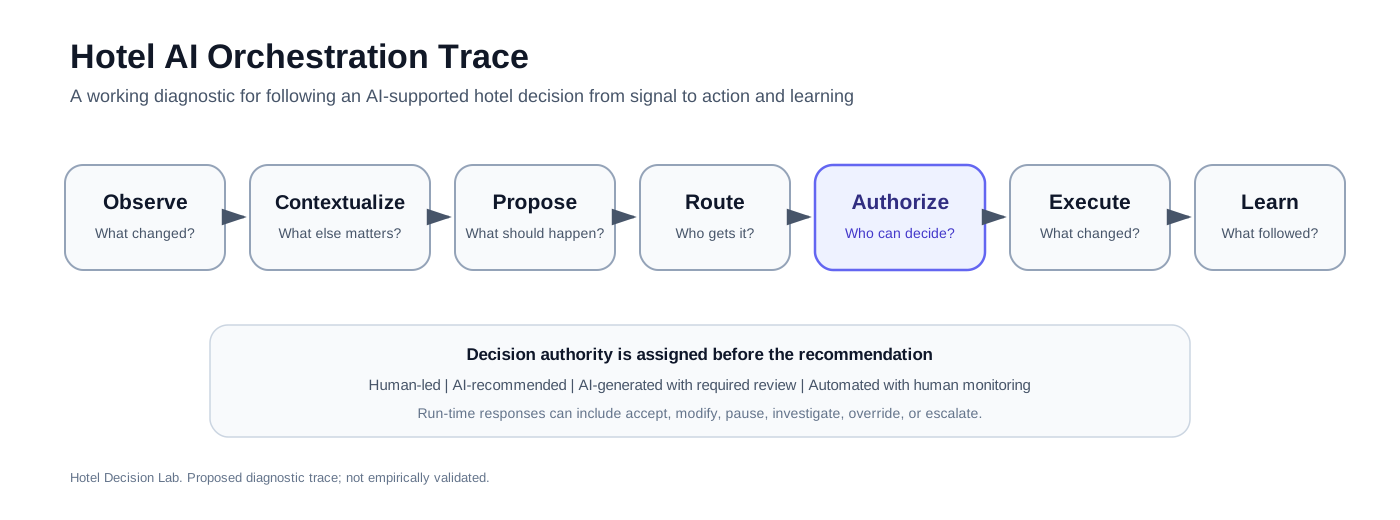
The trace is not a validated hotel framework. Treat it as a diagnostic for finding where a decision is actually breaking.
Observe
What signal started the decision?
For a housekeeping labor decision, that might be projected departures, stayovers, arrivals, rooms remaining, or a demand change. The first question is basic: what is the authoritative source, and how current is it?
Contextualize
What material information changes the meaning of that signal?
A service elevator may be down. A group may be arriving earlier than expected. Several room attendants may be in training. Local information belongs here when it is specific, timely, material, and not already represented by the system.
Propose
What action does the system recommend?
This is the recommendation stage in the Canon. A useful proposal should make the objective and the relevant constraints visible. Cutting labor is not a complete objective if the likely result is late rooms, unreasonable workloads, or service failures.
A proposal can also be "investigate this before acting."
Route
Who needs to receive the proposal or exception?
This is the handoff problem that ordinary integration often hides. A recommendation can be technically delivered and still fail if it lands in the wrong queue, waits on an unavailable reviewer, or reaches someone who does not own the decision. Routing should get the proposal, its context, and any exception to the person or workflow with authority to act.
Authorize
Who is allowed to decide?
This is the operating-decision stage. HDL's existing design-time modes already cover the useful choices:
- human-led
- AI-recommended
- AI-generated with required review
- automated with human monitoring
The right mode should be assigned before the recommendation arrives, not invented in the moment. Organizational research likewise treats delegation and the sequencing of human and AI decisions as design choices rather than a single default structure (Shrestha, Ben-Menahem, & von Krogh, 2019).
The choice should depend on demonstrated comparative capability, data quality, stakes, reversibility, error detectability, employee and guest consequences, feedback speed, and accountability.
Execute
What actually changed?
A schedule changed. Work was reassigned. Overtime was reduced. An employee was called in.
Once authorized, the downstream workflow still has to carry the decision through. A successfully transmitted message does not prove that coverage changed. Execution should be logged separately from the recommendation and separately from approval.
Learn
What happened afterward, and what can we reasonably learn from it?
This is where hotels need discipline. If overtime falls after a recommendation, that alone isn't enough to say the recommendation caused the improvement. Demand may have changed. An event may have cancelled. The weather may have shifted. A new manager may have changed another process.
The system should preserve the recommendation, the authorized decision, the executed action, and the observed outcome as separate records.
Learning may mean changing a workflow, a decision rule, an escalation path, or a data input. It doesn't automatically mean retraining the model.
Human review only works when review can catch something
One public Destination AI session offered a useful example.
A speaker described reviewing an AI-assisted analysis that was headed to a hotel owner. The analysis credited search-engine marketing with growth in direct business. The reviewer noticed that the category being used didn't isolate the bookings the analysis claimed to explain.
The detail that matters is how the error got caught. The catch wasn't a guaranteed control. The speaker said he had happened to look at the deck.
That changes the lesson. Having a human reviewer didn't make the workflow safe. A knowledgeable person happened to notice the problem, and that is a much stronger argument for designing review on purpose.
HDL's existing research position is that useful human review depends on informational advantage, diagnostic competence, and governance alignment. The reviewer needs relevant context, the ability to recognize a consequential error, enough time to inspect it, and the authority to intervene.
Research outside hospitality also warns against treating human involvement as an automatic safety feature. Sele and Chugunova (2024) found that allowing participants to adjust algorithmic recommendations increased algorithm uptake while slightly reducing accuracy in the prediction task studied. Mean absolute deviation (lower is better) was 18.0 in the adjustment condition versus 17.4 under delegation, with p = 0.04. The human and algorithmic advice in that experiment were curated to equal quality.
It isn't a hotel staffing study, and it isn't a case for automating more. The narrower lesson is not to confuse "a person touched the decision" with "the decision got safer."
Orchestration can make mistakes travel faster
There's an obvious counterargument to everything above. If hotel systems become more connected, AI may eventually handle much of the orchestration itself. That could shrink the problem.
Agents could gather context, route approvals, reconcile systems, and confirm execution. Managers already handle a lot of this coordination through stand-ups, calls, spreadsheets, and informal escalation. Maybe the real constraint is management capacity, not orchestration as a distinct problem.
That's plausible.
There's a second issue, though. Tighter coupling can also make a bad decision spread faster. If a poor recommendation moves automatically from forecast to schedule to employee notification, the hotel has created a very efficient error.
Faster execution of a poor recommendation is not improvement.
That moves the design question away from how tightly everything can be connected and toward three narrower ones: where speed helps, where review adds value, and where an action is consequential enough to require a pause.
Reversibility matters here. Changing a draft staffing plan is easier to undo than sending someone home after they've already arranged transportation or childcare. The same confidence level shouldn't automatically produce the same authority.
Multi-agent systems make the authority problem harder
The same logic applies as hotels experiment with agents.
Imagine a revenue agent sees soft demand and proposes a promotion. At the same time, a labor agent sees the same soft demand and proposes reducing coverage. Each recommendation can make sense inside its own objective. Together, they may create a service problem if the promotion works.
That scenario is illustrative. It isn't a reported hotel incident.
But it shows why "agent-to-agent communication" is not enough. The hotel still needs rules for permissions, precedence, conflicts, escalation, monitoring, and accountability. Who wins when two agents disagree? Which action can be reversed? Which action affects employees or guests? Who is accountable if a coordinating agent makes the wrong tradeoff?
Adding another agent to coordinate the agents doesn't answer those questions. It just moves the authority problem up a level.
The strongest version of the orchestration claim is testable
The weak version of this argument would be:
Better orchestration can improve results.
That claim can barely fail.
A more useful HDL proposition is narrower:
For a defined hotel decision class in which the same AI capability and operating data are held constant, a workflow with explicit decision authority, routing, execution confirmation, and feedback should outperform the current workflow on pre-specified decision-quality outcomes if orchestration is a material constraint.
That proposition can be wrong. If the redesigned workflow produces no improvement, or makes results worse, while model capability and relevant operating conditions remain comparable, that counts against the orchestration explanation.
The comparison would also need to look past labor cost. Decision quality may include service performance, employee burden, guest consequences, financial impact, reversibility, and recoverability.
This is still a proposition. No reviewed hotel study in HDL's current evidence base directly tests it.
What operators can do now
You don't need a new platform to test whether this problem exists.
Pick one recurring decision. Not "labor management." One decision, such as reducing afternoon housekeeping coverage after a demand change.
Then trace it end to end:
- Where did the signal come from?
- What context could change it?
- What exactly did the system propose?
- Who had authority to decide?
- Where did the approved decision go?
- What actually changed?
- What outcome followed?
- Where could the process pause or escalate?
If you can't answer those questions from the current workflow, adding another model may not solve the operating problem. It may just create a smarter recommendation sitting in the same broken handoff.
That is the orchestration proposition worth testing: whether a capable AI recommendation can reliably become a good hotel decision.
Sources and disclosure
This article is a research-informed conceptual essay. It does not claim that orchestration is now the dominant constraint across hotels.
No reviewed hotel study in the current Hotel Decision Lab evidence base directly tests the orchestration proposition. The hotel-specific conference material used publicly here is limited to a public-session practitioner account. Private Destination AI conversations encountered through the author's professional work were reviewed as context but are not used as confirming evidence in the public argument because publication clearance is not documented in the current package.
Drew Potter attended Destination AI in a professional capacity and works in technical sales at Actabl. His professional experience informs the questions and interpretation in this essay but is not treated as independent empirical evidence. The article does not evaluate or endorse a particular vendor, product suite, or integration strategy.
Brynjolfsson, E., & Hitt, L. M. (2000). Beyond computation: Information technology, organizational transformation and business performance. Journal of Economic Perspectives, 14(4), 23-48. https://doi.org/10.1257/jep.14.4.23
Melville, N., Kraemer, K., & Gurbaxani, V. (2004). Review: Information technology and organizational performance: An integrative model of IT business value. MIS Quarterly, 28(2), 283-322. https://doi.org/10.2307/25148636
Potter, D. (2026, September 30). Destination AI public-session transcript. Unpublished transcript retained by the author.
Sele, D., & Chugunova, M. (2024). Putting a human in the loop: Increasing uptake, but decreasing accuracy of automated decision-making. PLOS ONE, 19(2), e0298037. https://doi.org/10.1371/journal.pone.0298037
Shrestha, Y. R., Ben-Menahem, S. M., & von Krogh, G. (2019). Organizational decision-making structures in the age of artificial intelligence. California Management Review, 61(4), 66-83. https://doi.org/10.1177/0008125619862257