One recommendation, several possible problems
At 6:15 a.m., a hypothetical 350-room hotel gets its housekeeping labor recommendation for the day.
The system expects 156 departures and 62 stayovers. It recommends a staffing plan built to finish rooms by the property’s target time while staying inside labor standards.
The executive housekeeper thinks the recommendation is wrong.
That disagreement could mean several different things.
A 48-room group may have cancelled after the system’s last data refresh. If so, the workload prediction underneath the recommendation is wrong.
The room forecast may be accurate and a service elevator may have failed at 5:50 a.m. If so, the staffing allocation doesn’t account for today’s productivity constraint.
The recommended headcount may be reasonable and three scheduled room attendants may still be in training. Then the problem sits in execution rather than forecast or allocation.
The system may also be optimizing an incomplete objective. It can represent labor cost and room readiness while barely representing service recovery, employee burden, fairness, or the risk created by premium rooms going late.
Or the manager may just say, “I always add two attendants on Tuesdays.”
Those are not equivalent reasons to intervene. Hotel organizations file all five under one heading: the manager overrode the forecast. That language buries the actual information problem.
The useful question is narrower than proximity to the operation. Does the manager know something specific and useful that the system does not?
Local knowledge is not a credential
Article 1 argued that human review isn’t automatically protective. It set three conditions for useful review: informational advantage, diagnostic competence, and governance alignment.
Article 2 takes the first one.
Informational advantage is easy to claim and hard to show. A general manager has local knowledge. An executive housekeeper has experience. A department head knows the team. All of that can be true without identifying the information that should change a recommendation.
Experience describes the person. Information describes what the person knows in this decision instance.
Confidence isn’t information. Professional identity isn’t information. Being on property isn’t information. Disagreeing with an unfamiliar recommendation isn’t information. A fact the system already represents isn’t incremental. A true fact that can’t move the current decision isn’t material.
Research outside hospitality backs the distinction. Logg, Minson, and Moore (2019) found that domain experts used advice less than nonexperts across several judgment tasks and discounted algorithmic advice more heavily. In one expert comparison, the experts’ probabilistic judgments came out less accurate than those of lay participants who received algorithmic advice. That should not be interpreted as evidence that hotel managers are worse decision-makers. It does show why expertise alone cannot stand in as evidence of better reliance.
The opposite risk is just as real. Nair and Huchzermeier (2024) studied demand forecasting at one bicycle company. Expert information helped most for innovative and new products, where historical data were less representative. The same experts showed systematic optimism on some high-volume products.
Experience supplied signal and bias at the same time.
That’s the tension. Experienced hotel managers may recognize conditions a corporate model can’t see. They may also be unusually confident in a pattern the system already captures, or one that no longer predicts anything.
A working definition of local information
Hotel Decision Lab uses this working definition:
Local information is timely, decision-relevant information about the property or operating environment that the system doesn’t have, doesn’t represent well enough, or materially underweights.
That’s narrower than managerial intuition, on purpose.
A group cancellation that happened after the last data refresh may qualify. An open engineering ticket on a failed service elevator may qualify. A recent change in room-attendant training status may qualify if the recommendation assumes standard productivity.
The manager still has to establish relevance. The elevator outage may matter to housekeeping allocation and not to the occupancy prediction. Training status may affect execution capacity and not room demand. A cancellation may change the prediction and make an otherwise sound allocation unnecessary.
The system’s side needs the same scrutiny. A manager may say the model doesn’t know about a local event when the event’s effect already shows up through reservations, pickup pace, group block changes, market segment, lead time, or another proxy. “There is no field called local event” doesn’t prove the model lacks the signal.
So local knowledge isn’t a synonym for whatever’s left in the manager’s head. The claim being made is about incremental information relative to a particular decision system.
First locate the disagreement
The current Hotel Decision Lab Canon separates the decision process into:
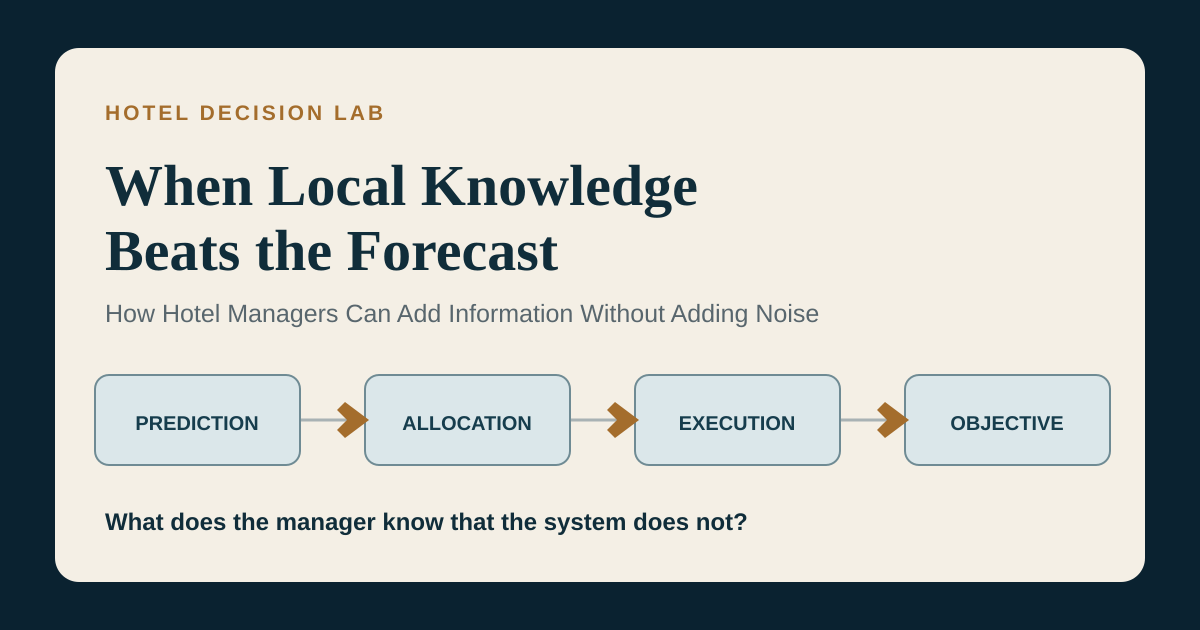
Prediction → Recommendation → Operating decision → Execution → Outcome
Article 2 extends that into four common correction types.
Prediction correction
The manager has information showing the underlying prediction is wrong.
In the housekeeping example, the system is still counting a group that cancelled after the last data update. Nobody is challenging the labor standard. The expected workload is what’s wrong.
Allocation correction
The prediction may be accurate while the recommendation misses a live operating constraint.
If the service elevator is unavailable, the expected rooms and cleans can be correct while the translation from workload to labor is wrong for today’s conditions.
Execution correction
The recommendation may be reasonable while the current team can’t run it as assumed.
Three attendants in training may need different assignments, coaching coverage, or a temporary productivity adjustment. The forecast may be fine. The scheduled headcount may be fine. The execution plan isn’t.
Objective correction
The model may be optimizing the wrong outcome, or an incomplete one.
A recommendation can minimize labor cost while barely representing employee burden, service risk, fairness, recovery capacity, or a contractual guest commitment. That’s not automatically a model failure. Sometimes the organization specified an incomplete objective and the model did exactly what it was told.
Each correction should enter the system in a different place. A cancellation belongs in demand or workload data. An equipment outage belongs in productivity constraints. Training status belongs in capability and execution assumptions. An incomplete objective belongs in governance and model design.
Run all four through a final manager override and the organization fixes today while learning nothing about why the recommendation failed.
When human information improves a forecast
The strongest reviewed field evidence for human-model complementarity comes from outside hospitality.
Nair and Huchzermeier (2024) compared pure expert judgment, machine-learning forecasts, and an integrated approach using demand data from Canyon Bicycles. Reported weighted mean absolute percentage error was 50 for pure judgment, 38 for machine learning, and 33 for the integrated approach.
The two contributions weren’t equally useful everywhere. Expert information did more for innovative or new products. Historical data did more for carried-over products. The integrated approach also accounted for recurring expert optimism.
So the finding isn’t that experts beat models. A structured integration of different information sources outperformed either source alone at one firm, and the human source carried systematic bias while doing it.
Two abstract-only studies point the same direction with qualifications.
Fildes, Goodwin, Lawrence, and Nikolopoulos (2009) report in their abstract that they analyzed more than 60,000 forecasts and outcomes from four supply-chain companies. Judgmental adjustments improved average accuracy at three of them. Larger adjustments tended to improve accuracy more. Smaller ones often made it worse. Upward changes were less likely to help and more often went the wrong direction, which the authors read as optimism bias.
Blattberg and Hoch (1990) report in their abstract that combined model-manager forecasts beat either input alone across five business settings. Their equal-weight combination produced an average cross-validated R-squared increase of .09 over the stronger single input.
Neither abstract establishes a hotel rule. Fildes and colleagues don’t establish that a larger hotel adjustment is a better one. Blattberg and Hoch don’t establish that hotels should run 50/50. Both studies sit inside structured forecasting processes, not unrestricted final authority over a hotel labor recommendation.
The safe conclusion is narrower:
Human information can improve a model-supported forecast when it contributes a distinct signal and the integration process limits recurring bias.
That conclusion rests on transferred evidence. It hasn’t been validated in hotel labor operations.
When managerial intervention becomes noise
The same evidence base gives strong reasons for caution.
Sele and Chugunova (2024) compared delegation with a human-in-the-loop condition in an online prediction experiment. Participants and the algorithm had the same information. Adjustment rights raised algorithm uptake and participant confidence, and final decisions came out less accurate. Participants were least likely to correct the largest errors.
The information condition is the critical distinction. The human held no property fact, no new signal, no missing operational constraint. Intervention added another judgment layer without adding another information source.
Dietvorst, Simmons, and Massey (2018) found a related split between control and performance. Letting people make even small changes to an algorithm increased their willingness to use it. Bounded adjustment preserved more of the algorithm’s accuracy. Unrestricted adjustment cut it.
Control moved adoption more reliably than it moved the forecast.
The field evidence is cautionary too. Kesavan and Kushwaha (2020) report in their abstract that discretionary override authority reduced profitability by 5.77% overall at an automobile replacement-parts retailer. Merchants improved profit on growth-stage products and reduced it on mature and declining ones.
The abstract doesn’t say whether the average loss came from bias, duplicated information, incentives, poor implementation, or another mechanism. It does show why discretionary authority can’t be justified by the possibility of private information alone.
Noise can enter through several pathways:
- habitual adjustment, especially when no new fact can be named
- optimism or pessimism
- recency after a visible model failure
- professional identity and the pull to protect autonomy
- overconfidence that tracks tenure or status
- resistance to an unfamiliar recommendation
- incentives tied to labor targets, service scores, or political expectations
- adjustments based on information the model already represents
- repeated intervention in stable operating regimes
Most of these haven’t been demonstrated specifically among hotel managers. They come from transferred evidence or remain plausible hotel propositions, and that difference matters. I’m not claiming hotel managers routinely behave this way. I’m naming mechanisms an evidence-based process should be able to detect.
Novelty creates an opportunity, not a permission slip
The relative value of human information may shift when historical patterns stop representing current operations.
The best support comes from Nair and Huchzermeier’s comparison of new and carried-over products. Newness and innovation increased the relative contribution of expert information. Kesavan and Kushwaha’s abstract reports a related life-cycle pattern: discretion helped growth-stage products and hurt mature and declining ones.
Together, these findings provide moderate transferred support for novelty and sparse history as conditions that may create greater opportunity for useful human information.
It doesn’t make the manager superior whenever conditions get unusual.
Novelty weakens a model because its historical data no longer describe the current regime. Novelty can weaken the manager the same way. A first-time event may sit outside everyone’s experience. A disruption brings urgency, incomplete information, and confidence that outruns both. Being close to the operation doesn’t solve any of that automatically.
The evidence gets thinner exactly where operators care most.
- Novel or sparse-history regimes: moderate transferred support.
- Regime change and disruption: preliminary to moderate transferred support, depending on how closely the mechanism resembles the field studies.
- Recent events not yet captured in data: preliminary transferred support from qualitative process evidence, plus a strong operating inference.
- Temporary property constraints, unusual group behavior, local events, training changes, equipment failures, and short-term service constraints: plausible hotel mechanisms, unsupported as general outcome rules in the reviewed hotel evidence.
Those belong in the research agenda, not in a list of approved override triggers.
Where human information enters the process matters
The two Kesavan field experiments create an important unresolved contrast in the current evidence base.
Kesavan and Kushwaha (2020) studied discretionary authority to override a data-driven tool. As noted, the abstract reports a 5.77% average profit reduction, with better results on growth-stage products.
Kesavan, Kushwaha, and Steele (2026) studied judgmental changes to forecast inputs supplied to an inventory algorithm. Their abstract reports a 4.92% average profit increase against automation with no human intervention. Effects varied with item margin, life cycle, and supplier size. The abstract also stresses that forecast performance and profit performance are different outcomes.
The tempting read is that upstream input adjustment works and downstream override fails.
The evidence does not support that conclusion.
The studies differ in intervention, sample, item conditions, implementation, and probably model and organizational context. Full texts weren’t available for review in this project. There’s no common experiment isolating intervention stage.
The contrast still raises a serious question.
Human information can enter before the prediction, as an input to the forecast, during the translation from forecast to staffing recommendation, during execution, or after the final recommendation appears. Each position creates its own opportunity and its own risk.
Upstream integration may let a local signal into the process while keeping the model process disciplined. It may cut hindsight-driven adjustment and make the information available across related decisions.
It can also create stale inputs, double counting, strategic manipulation, administrative burden, and false precision. Formalizing context strips the nuance out of it. A temporary exception becomes a permanent field and outlives its usefulness by years.
Intervention stage is a variable worth studying. Current evidence doesn’t name a superior stage for hotel labor decisions.
A proposed local-information test
Hotel organizations need a way to tell this:
I disagree with the recommendation.
apart from this:
The system does not represent X. X materially affects Y at this point in the decision chain. So I propose changing Z.
Hotel Decision Lab proposes five questions. This is an unvalidated operating test with no numerical score, no weighting, no threshold.
1. What exactly is the fact, and what is its basis?
The claim has to be specific enough that another person can understand what the manager knows and how the manager knows it.
“The elevator is affecting us” is weak. “The service elevator failed at 5:50 a.m., engineering ticket 1842 is open, and housekeeping is running guest elevators” is specific and sourced.
2. Is it actually incremental?
Determine whether the system receives the fact directly or represents its likely effect through another variable or proxy.
If the model already has the cancellation, the manager isn’t adding a demand signal. There may still be an allocation or execution problem worth raising. The prediction correction is duplicative.
3. Where does it matter?
Locate the issue in prediction, recommendation or allocation, execution, or objective.
This is what stops an organization from changing the demand forecast to compensate for an equipment problem, or using a staffing override to paper over an incomplete objective.
4. Is it material and timely for this recommendation?
The fact has to be capable of moving the current decision by an amount worth acting on. A true but stale or immaterial fact doesn’t establish informational advantage.
Materiality depends on the decision and its consequences. The same elevator outage is minor on a low-departure day and serious during a compressed convention turnover.
5. Can the result be evaluated later?
Define which outcomes would show that acting on the information improved the decision. Room readiness, productivity, overtime, inspection quality, employee burden, guest recovery, financial impact.
Evaluation is necessary and not sufficient for causal proof. A good outcome after an override can come from luck, execution, or another change nobody measured. Repeated comparisons and stronger research designs are still the price of a causal claim.
Passing these questions doesn’t validate the proposed staffing change. It gets the manager to a structured, auditable information claim instead of an unsupported assertion about experience.
From downstream override to upstream information capture
The proposed test raises its own question.
If a manager repeatedly holds information that improves a recommendation, why does that information keep living outside the decision system?
A downstream override happens after the manager sees the recommendation and changes it. Upstream integration supplies relevant context before the prediction or recommendation is generated.
Candidate hotel inputs: local-event conditions, group arrival or departure changes, room outages, training status, equipment failure, unusual service commitments, temporary productivity constraints, new operating policies.
Not every example should become a permanent field. Some local facts are one-time exceptions. Some are ambiguous. Some are expensive to collect. Some invite manipulation. Others are already represented well enough by existing data.
The defensible starting proposition is narrower:
When a recurring local signal repeatedly improves relevant outcomes, the organization should evaluate whether it belongs upstream in the decision system rather than remaining permanently dependent on post-hoc override.
That evaluation should ask:
- Does the signal recur often enough to structure?
- Can it be defined without stripping out the nuance that makes it useful?
- Can its source and timeliness be verified?
- Will adding it duplicate an existing input or proxy?
- Can managers game it toward a preferred labor result?
- Does it improve the relevant operating outcome across comparable conditions?
- Should it stay a temporary exception, trigger a pause, or become a model input?
That’s a Hotel Decision Lab proposition. Current evidence doesn’t show that upstream information capture is superior in hotel labor operations.
What hotel-specific evidence does and does not establish
Hospitality research confirms the problem is real and doesn’t resolve it.
Ivanov and Webster (2024) surveyed 130 hotel managers across 23 decisions in eight functions. Managers were generally positive toward AI and wanted to keep control. Human-out-of-the-loop arrangements were the least preferred, especially for decisions perceived to require emotional intelligence.
That’s evidence about stated preference. It says nothing about whether retained manager control improves a labor decision.
Kumawat and colleagues (2025) reviewed 80 empirical hospitality employee studies. Employee responses to AI were associated across that literature with usefulness, ease of use, trust, risk, uncertainty, organizational support, AI awareness, and anticipated work consequences. The literature clustered in particular geographic and service-robot contexts and offered little direct evidence about manager overrides of labor recommendations.
Kozlovskis and colleagues (2023) compared several machine-learning approaches with an econometric benchmark using occupancy data from one hotel. The strongest machine-learning specification didn’t beat the benchmark. That’s an argument for local comparative validation. It isn’t evidence that hotel forecasting models are generally weak or that managers forecast better.
The closest hotel demand-and-staff-scheduling article located in this project, Li, Zheng, and Lin (2026), stayed abstract or bibliographic only because the accepted manuscript couldn’t be retrieved for review. I’m not using it to claim anything about manager intervention or downstream outcomes.
Inside the bounded evidence set reviewed for Hotel Decision Lab, no full-text hotel study connected recommendation-level manager intervention with downstream labor, service, employee, guest, or financial outcomes.
That’s a result of this evidence set. It isn’t proof the topic has never been studied, and it isn’t a claim of academic novelty.
The current hotel evidence does not prove that:
- managers improve AI-supported labor recommendations
- local knowledge usually improves forecasts
- experienced managers override more accurately
- bounded adjustment improves hotel outcomes
- AI labor recommendations generally outperform hotel managers
- post-hoc human override improves employee, guest, labor, service, or financial outcomes
- upstream information capture is superior in hotels
All of that is still open.
What hotel organizations can reasonably consider now
The evidence is incomplete, and the choice still isn’t between blind deference and unrestricted discretion.
The defensible starting point is to make manager information visible and evaluable.
Require the missing fact, not a confidence statement
Ask what the manager knows, how the manager knows it, and why it matters this morning. “My experience says the system is wrong” doesn’t clear the bar.
Show what the system sees
Managers can’t identify incremental information when inputs, freshness, proxies, coverage limits, and known blind spots are invisible to them. The goal is diagnosis, not persuasion.
Separate correction types
Record whether the intervention concerns prediction, allocation, execution, or objective. Different problems, different fixes.
Use structured reasons without treating them as proof
Reason categories support later analysis. A little free text preserves nuance. Documentation creates traceability. It does not make the reason correct.
Evaluate outcomes, not override frequency
A low override rate can mean strong recommendations, automation bias, pressure, or administrative friction. A high rate can mean poor coverage, useful local information, or habit. The rate alone can’t tell you which.
Examine manager-specific patterns across comparable regimes
Some managers may consistently improve particular decision classes. Others may show recurring optimism or pessimism. Any comparison has to account for property, season, disruption, decision type, and what information was available at the time.
Review recurring signals for upstream capture
Repeated useful exceptions may point to a missing input, weak integration, or a model being used outside its coverage. They may also point to one manager’s recurring bias. Both possibilities deserve investigation.
Preserve pause and escalation
Some recommendations arrive when neither the model nor the manager has adequate information. A defensible authority design lets the decision pause, investigate, or escalate instead of forcing accept-or-override on the spot.
These are reasonable operating considerations. They aren’t validated hotel best practices.
Five propositions for future hotel research
Article 2 proposes five testable relationships.
Proposition 1: Incremental information
Manager intervention is more likely to improve an AI-supported labor recommendation when the manager contributes timely, material information that the system doesn’t adequately represent.
Proposition 2: Regime novelty
The opportunity for manager-supplied information to add value may increase when historical patterns are less representative of current operating conditions. Novelty by itself doesn’t establish human superiority.
Proposition 3: Duplicative or habitual intervention
Intervention is less likely to add value when the manager and the system rely on substantially the same information, or when adjustment recurs without an identifiable incremental fact.
Proposition 4: Intervention stage
The value and risk of manager information may differ depending on whether it enters before prediction, as a forecast input, during recommendation or allocation, at execution, or after the recommendation appears.
Proposition 5: Upstream capture
When a recurring local signal repeatedly improves relevant outcomes, organizations should evaluate whether it belongs upstream in the decision system rather than remaining permanently dependent on post-hoc override.
These can be tested at the recommendation-instance level. A future study would record what the system knew, what the manager claimed to know, whether that information was incremental, where it entered the chain, what action followed, and which outcomes resulted. Strong designs would compare human-only, AI-only, structured input, bounded adjustment, unrestricted override, pause, and escalation where that’s feasible.
Acceptance can’t be the outcome measure. The outcome has to include what the decision is supposed to protect: labor cost, productivity, service, employee burden, fairness, guest consequences, recoverability, and financial effect.
Research method and evidence limitations
This article draws on the Hotel Decision Lab structured integrative review. It isn’t a formal systematic review.
Several of its most important findings are transferred from retail, supply-chain forecasting, human-factors, organizational, and controlled experimental settings. Those mechanisms may be relevant to hotels. They haven’t been validated in hotel labor operations.
Four priority forecasting papers stayed abstract-only after targeted lawful retrieval attempts: Fildes et al. (2009), Blattberg and Hoch (1990), Kesavan and Kushwaha (2020), and Kesavan, Kushwaha, and Steele (2026). Claims from those papers stop at what their official abstracts disclose.
Hotel-manager preferences don’t establish decision quality. Forecast accuracy doesn’t establish staffing-decision quality. Profit doesn’t capture every employee, guest, service, fairness, or operational consequence.
Evidence on managerial adjustment is context-dependent and contradictory. The proposed local-information test isn’t validated. The upstream-information proposition has not been demonstrated in the hotel labor evidence reviewed here. The absence of a direct hotel labor intervention study in this reviewed set isn’t proof of academic novelty.
My hotel experience shaped the hypothetical scenario and the operating questions. It isn’t empirical evidence.
The standard is incremental information
Back to 6:15 a.m.
The executive housekeeper may know something important. The group may have cancelled. The service elevator may be down. The team on the board may not match the model’s assumption about what a team can do. The objective may be incomplete.
Each of those claims points to a different correction.
“I always add two attendants” points to nothing.
Proximity makes useful information easier to obtain. Experience helps a manager recognize why it matters. Neither one establishes informational advantage without the information itself.
The better questions:
- What exactly does the manager know?
- Does the system already represent it?
- Where does it matter in the decision chain?
- Is it material right now?
- Can the organization learn from the result?
Local information shouldn’t get celebrated because a manager caught an exception. It should get tested.
And if the same useful exception keeps coming back, the question stops being whether the manager should override the recommendation.
It becomes why the decision system still doesn’t know.
References
Athey, S. C., Bryan, K. A., & Gans, J. S. (2020). The allocation of decision authority to human and artificial intelligence. AEA Papers and Proceedings, 110, 80-84. https://doi.org/10.1257/pandp.20201034
Bader, V., & Kaiser, S. (2019). Algorithmic decision-making? The user interface and its role for human involvement in decisions supported by artificial intelligence. Organization, 26(5), 655-672. https://doi.org/10.1177/1350508419855714
Blattberg, R. C., & Hoch, S. J. (1990). Database models and managerial intuition: 50% model + 50% manager. Management Science, 36(8), 887-899. https://doi.org/10.1287/mnsc.36.8.887
Burton, J. W., Stein, M. K., & Jensen, T. B. (2020). A systematic review of algorithm aversion in augmented decision making. Journal of Behavioral Decision Making, 33(2), 220-239. https://doi.org/10.1002/bdm.2155
Dietvorst, B. J., Simmons, J. P., & Massey, C. (2018). Overcoming algorithm aversion: People will use imperfect algorithms if they can even slightly modify them. Management Science, 64(3), 1155-1170. https://doi.org/10.1287/mnsc.2016.2643
Fildes, R., Goodwin, P., Lawrence, M., & Nikolopoulos, K. (2009). Effective forecasting and judgmental adjustments: An empirical evaluation and strategies for improvement in supply-chain planning. International Journal of Forecasting, 25(1), 3-23. https://doi.org/10.1016/j.ijforecast.2008.11.010
Guo, Z., Wu, Y., Hartline, J., & Hullman, J. (2024). A decision theoretic framework for measuring AI reliance. Proceedings of the 2024 ACM Conference on Fairness, Accountability, and Transparency, 221-236. https://doi.org/10.1145/3630106.3658901
Ivanov, S., & Webster, C. (2024). Automated decision-making: Hoteliers’ perceptions. Technology in Society, 76, 102430. https://doi.org/10.1016/j.techsoc.2023.102430
Kesavan, S., & Kushwaha, T. (2020). Field experiment on the profit implications of merchants’ discretionary power to override data-driven decision-making tools. Management Science, 66(11), 5182-5190. https://doi.org/10.1287/mnsc.2020.3743
Kesavan, S., Kushwaha, T., & Steele, D. (2026). Profit implications of judgmental adjustments to forecast inputs: Evidence from a large-scale field experiment. Management Science, 72(1), 119-127. https://doi.org/10.1287/mnsc.2024.06321
Kozlovskis, K., Liu, Y., Lace, N., & Meng, Y. (2023). Application of machine learning algorithms to predict hotel occupancy. Journal of Business Economics and Management, 24(3), 594-613. https://doi.org/10.3846/jbem.2023.19775
Kumawat, E., Datta, A., Prentice, C., & Leung, R. (2025). Artificial intelligence through the lens of hospitality employees: A systematic review. International Journal of Hospitality Management, 124, 103986. https://doi.org/10.1016/j.ijhm.2024.103986
Lee, J. D., & See, K. A. (2004). Trust in automation: Designing for appropriate reliance. Human Factors, 46(1), 50-80. https://doi.org/10.1518/hfes.46.1.50_30392
Li, J., Zheng, W., & Lin, Z. (2026). Predicting and planning: An intelligent system for demand-based hotel staff scheduling. International Journal of Hospitality Management, 133, 104474. https://doi.org/10.1016/j.ijhm.2025.104474
Logg, J. M., Minson, J. A., & Moore, D. A. (2019). Algorithm appreciation: People prefer algorithmic to human judgment. Organizational Behavior and Human Decision Processes, 151, 90-103. https://doi.org/10.1016/j.obhdp.2018.12.005
Nair, D., & Huchzermeier, A. (2024). Predictably unpredictable? How judgmental and machine learning forecasts complement each other. Production and Operations Management, 33(5), 1214-1234. https://doi.org/10.1177/10591478241245138
Sele, D., & Chugunova, M. (2024). Putting a human in the loop: Increasing uptake, but decreasing accuracy of automated decision-making. PLOS ONE, 19(2), e0298037. https://doi.org/10.1371/journal.pone.0298037
Shrestha, Y. R., Ben-Menahem, S. M., & von Krogh, G. (2019). Organizational decision-making structures in the age of artificial intelligence. California Management Review, 61(4), 66-83. https://doi.org/10.1177/0008125619862257